In many teams, some of the most important knowledge is never written down.
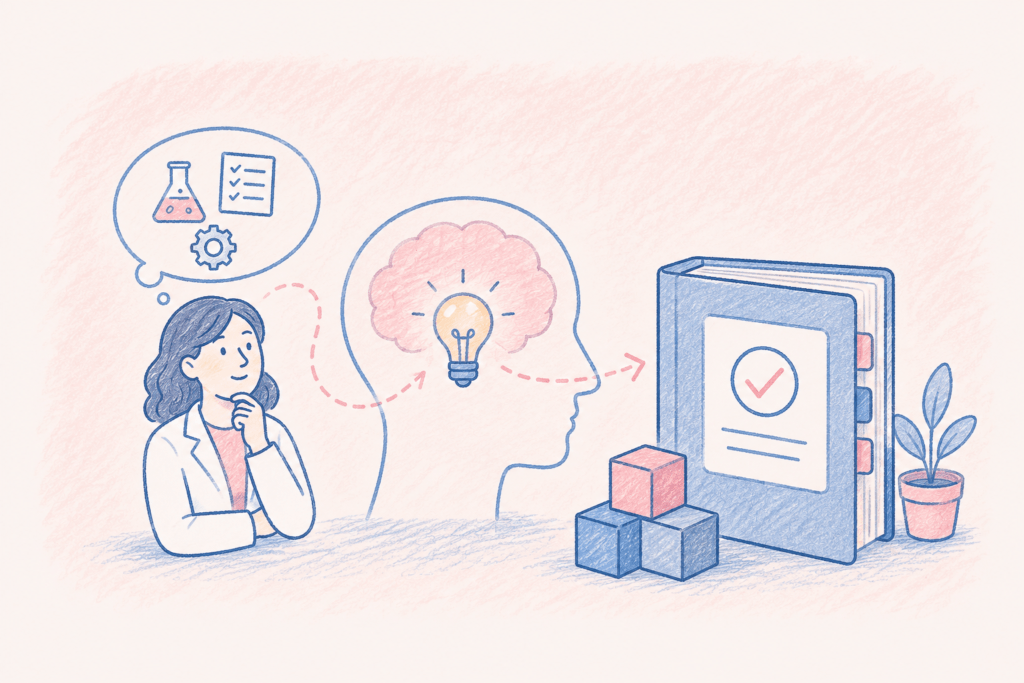
It lives in the heads of experienced staff, senior researchers, long-term technicians, project leads, or the one person who “just knows how things are done”.
At first, this may not seem like a problem. In small teams, it can even feel efficient. If someone has a question, they ask the person who knows. If something goes wrong, the experienced team member steps in. If a method needs adjusting, the team relies on memory, habit, or informal conversations.
But over time, this creates risk.
When knowledge stays with individuals instead of being built into systems, the organisation becomes dependent on specific people. If that person is away, leaves the team, changes roles, or simply forgets a detail, the process becomes harder to repeat consistently.
This is especially important in research, manufacturing, engineering, and other technical environments where small details can significantly affect outcomes.
A method may look simple on paper, but the real knowledge might sit outside the procedure.
What are some examples?
A researcher knows that one reagent needs to warm slightly longer than the current written method says.
A line operator knows one mixing machine runs hotter than its display reads and mentally adjusts timing accordingly, but the calibration offset is never documented.
A team member knows which supplier tends to have batch variation, but this information is shared verbally rather than recorded.
A project lead knows why a process was changed, but the reason was never added to the document history.
These details may seem minor, but they are often the difference between a process that works once and a process that can be repeated, understood, and trusted.
The problem is not that people hold knowledge. Experienced staff are valuable because they build practical understanding over time. The issue occurs when that knowledge has no pathway into the system.
If knowledge is only transferred through memory, informal training, or “watch how I do it”, consistency becomes fragile. New staff may learn slightly different versions of the same process. Important decisions may be repeated without anyone knowing why they were made. Mistakes may recur because the lesson from the last issue was never formally captured.
How a Quality Management System helps capture knowledge before it disappears
A Quality Management System helps turn individual knowledge into shared organisational knowledge. It provides structure for documenting procedures, recording changes, capturing lessons learned, reviewing risks, and making sure everyone works from the same information.
This does not mean every small detail needs to become a complicated document. A good system should make knowledge easier to access, not harder to use.
A QMS can support this in several practical ways:
1.Turn informal knowledge into clear procedures
A QMS encourages teams to turn repeated tasks into clear, usable SOPs or work instructions. These documents should reflect how the work is actually performed, including critical details that may not be obvious to new staff.
For example, if an experienced team member knows that a sample needs extra mixing, a reagent must be handled within a certain timeframe, or a machine requires a specific setup step, that information should not stay informal. It should be built into the procedure.
This helps ensure the process is not dependent on who happens to be available that day.
2.Record the reason behind changes
Processes often change for good reasons. A method may be adjusted to improve efficiency, reduce errors, respond to new equipment, or address a recurring issue.
The problem begins when the change is remembered, but the reason is not.
A QMS supports version control and change management so teams can record what changed, why it changed, who approved it, and when it took effect. This creates a history of decision-making, rather than leaving future staff to guess why a process is done a certain way.
Without this, teams can end up following steps that made sense years ago but no longer match the current context.
3.Make training consistent
When knowledge stays in people’s heads, training often becomes inconsistent.
One new staff member may be taught one version of a process, while another learns a slightly different version from someone else. Over time, these small differences can lead to variation in results.
A QMS helps make training more structured. It can define who needs to be trained, what they need to know, which documents they should use, and how training is recorded.
This does not replace hands-on teaching. It strengthens it by making sure everyone is trained against the same expectations.
4.Review processes before they become outdated
Even well-written procedures can become outdated if they are never reviewed.
A QMS creates a routine for checking whether processes still reflect current practice. Teams can ask:
- Is this procedure still accurate?
- Are people actually following it?
- Have there been repeated issues?
- Has equipment, staffing, supplier risk, or workflow changed?
- Is important knowledge still sitting outside the document?
Regular review prevents processes from becoming disconnected from reality. It also gives teams a chance to bring informal knowledge back into the system before it becomes a risk.
Closing
When knowledge stays only in people, it creates dependency. The team may function well while those people are present, but the system becomes fragile when they are away, overloaded, or leave.
A strong QMS does not remove the value of experienced people. It protects and shares what they know.
It turns individual knowledge into organisational knowledge.
That means clearer procedures, stronger training, better traceability, and fewer repeated mistakes. Most importantly, it helps teams keep improving without relying on memory alone.
A QMS is only as strong as the knowledge built into it. Zero to Quality is a structured program for researchers and technical teams who want to learn and build that foundation properly.