Scientific training does an good job of teaching how to run experiments. Students learn to follow protocols, operate equipment, analyse data and interpret results. By the time they finish an undergraduate degree or move into an early research role, the technical foundations are solid.
However, there is a gap that can often go unnoticed. How to ensure those results are reliable.
It’s an easy gap to miss. In short lab sessions, under the pressure of completing required experiments and filling out documentation, the focus naturally lands on what was achieved rather than how consistently it can be achieved. Experiments are often repeated until the expected result is achieved, variability is accepted without deeper investigation and documentation is often minimal. Methods might change informally with small adjustments made along the way but rarely tracked in a structured manner.
These behaviours are rarely intentional but are a natural outcome of an environment where the priority is completing tasks within limited timeframes rather than building systems for quality.
What is the problem?
Applied research works differently.
A result obtained once may be enough to fill out the lab manual or finish an assignment, but a it is not enough to build on. It depends on whether that result can be reproduced, understood and trusted over time. This is where quality thinking matters and the gap appears between undergraduate experience and real-world research practice shows up.
Introducing quality thinking early does not require full systems or formal frameworks. It can begin with implementing simple principles.
Ways to Start Introducing Quality Thinking
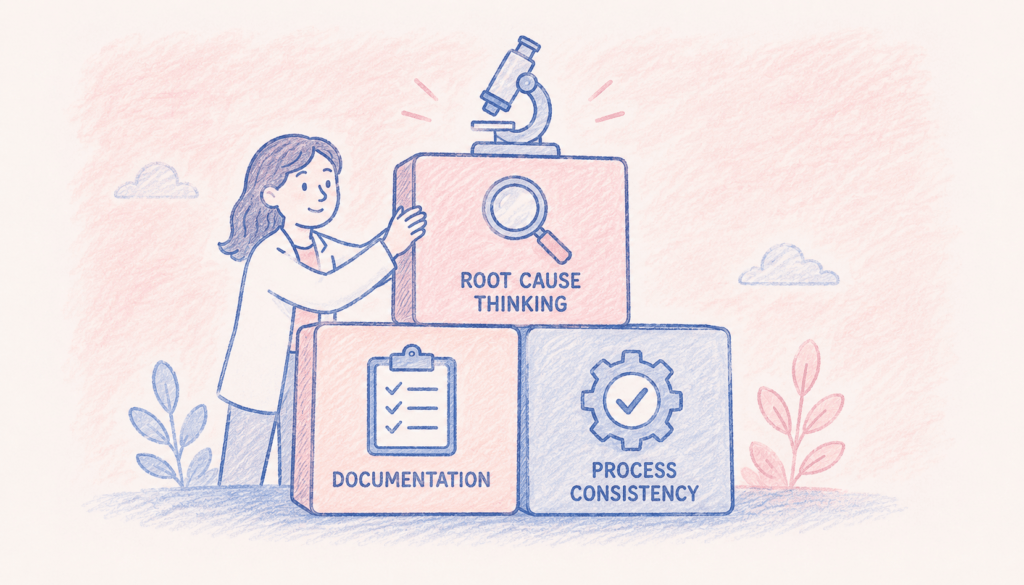
1.Encourage structured documentation
Whilst lab manuals provide a clear set of instructions, what actually occurs can differ from the expected outcome. As a result, students should be encouraged to document real observations during the experiment including small deviations, unexpected results, timing differences and environmental factors that may influence outcomes.
This shifts documentation from being a checklist of steps to a detailed observational record which provides greater insight into how the results were obtained and making it easier to identify sources of variability.
2.Introduce basic root cause thinking
When a result doesn’t come out as expected, the instinct is to repeat the procedure in the hope of achieving the correct outcome. This is understandable, especially in a time-pressured lab class. However, if students are in the habit of recording their observations, they have something to look back at first. By reviewing things such as deviations, timing differences or environmental factors, students can start to identify potential sources of variation.
This encourages a shift from asking “how do I get the right result?” to “why did this happen?”. Even simple reflection on possible causes helps develop an investigative mindset, where issues are explored rather than overlooked. Over time, this reduces repeated errors and builds a stronger understanding of how processes behave in practice.
3.Emphasing processes, not just results
In many academic settings, success is defined by achieving the expected outcome. But when the sole measure of success is the correct answer, consistency in how that answer was reached becomes invisible. Students learn to chase results.
However, focusing only on results can mask inconsistencies in how those results were obtained. By placing greater emphasis on the process, students begin to recognise that reliable methods are just as important as correct outcomes. This reinforces the idea that a result is only meaningful if it can be consistently reproduced under the same conditions.
The Next Step
These are small and manageable practices that are straightforward to implement and sit comfortably within existing teaching structures. What’s required are supervisors who model the mindset, and assessment design that gives weight to quality thinking alongside correct outcomes.
This shift provides researchers with a stronger foundation to approach research with greater consistency, transparency and confidence.
Researchers who will contribute most effectively to applied science will be the ones who not only produces great result, but the ones who understood why, and how they are able to reproduce that result. That kind of rigour doesn’t develop overnight. It develops in lab classes, supervised by people who treat it as worth developing.
Want to Learn More?
If you’re responsible for undergraduate research training or lab curriculum design and you’re thinking about how to build these habits into your program, the Zero to Quality course covers exactly this kind of foundational quality thinking — designed for research environments, without the jargon. It’s a practical starting point for labs that want to close the gap between technical training and real-world research practice. Contact us to learn more at info@zerotoquality.com or visit us at zerotoquality.com.au