At Zero to Quality, we often see teams rush straight to documentation, software, or certification when thinking about a Quality Management System (QMS). But strong, scalable quality doesn’t begin with tools. It begins with clarity.
That clarity comes from three simple foundations:
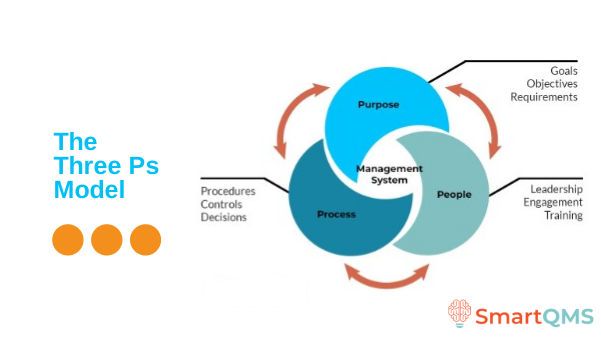
Purpose. People. Process.
These are the three Ps of effective quality management.
Think of the 3 Ps like 3 interacting atoms, continuously interacting with each securing the atomic bond. Remove one, and the whole thing collapses.
Purpose — Why Are We Doing What We’re Doing?
Purpose is where every strong QMS begins.
This is where teams step back and ask:
- Why does our organisation exist?
- What outcomes are we seeking?
- What risks might undermine our work?
- Who are we accountable to?
Without purpose, quality can quickly become bureaucracy. Teams document for the sake of it. Procedures multiply. Engagement fades.
But when quality is tethered to purpose, systems have real meaning. Controls make sense and documentation protects real value.
For startups and research teams, purpose often leads to:
- Greater scientific integrity
- Data that is trusted
- Deeper credibility with partners and investors
- Safe, scalable growth
A QMS built without purpose becomes a compliance exercise.
A QMS built with purpose becomes a strategic asset.
People — Who’s Doing the Work and Who Are We Doing It For?
Every QMS ultimately rises or falls on human behaviour.
People are both:
- The operators of the system
- And the beneficiaries of the system
This includes:
- Researchers
- Lab managers
- Founders
- Technicians
- Quality leads
- Commercial partners
- End users
- Students
A critical truth of quality management is this:
People don’t resist quality — they resist complexity and irrelevance.
If a QMS is imposed without:
- Training
- Ownership
- Feedback
- Cultural buy-in
it will be bypassed, worked around, or quietly ignored.
Effective quality systems make it clear:
- Who owns each process
- Who is affected if it fails
- Who depends on the data being right
When people understand their role in the quality story, behaviours shift. Documentation becomes protection, not admin. Controls feel supportive, not restrictive. Accountability becomes shared.
Process — How the Work Actually Happens
Process defines how things are really done:
- How experiments are designed
- How samples are tracked
- How equipment is maintained
- How deviations are managed
- How decisions are approved
- How records are reviewed
Weak processes create:
- Data gaps
- Rework
- Lost knowledge
- Audit stress
- Delayed translation
Strong processes create:
- Repeatability
- Traceability
- Continuity
- Confidence
- Scalability
But process must always reflect real workflows. A perfectly documented process that doesn’t align with how people actually work will fail just as surely as no process at all.
At Zero to Quality, we focus on right-sized processes — practical systems that evolve as organisations grow, not over-engineered frameworks that slow teams down.
Why the 3 Ps Must Work Together
The power of the 3 Ps model is that no element can survive alone:
- Purpose without process becomes aspiration with no execution
- Process without people becomes bureaucracy
- People without purpose become disengaged
But when Purpose, People and Process are aligned, quality becomes:
- Embedded, not bolted on
- Scalable, not fragile
- A growth enabler, not a compliance burden
Final Thought
A strong QMS doesn’t start with standards, software, or audits.
It starts with purpose that guides, people who care, and processes that work in the real world. Get the 3 Ps right — and quality becomes a competitive advantage, not an obstacle.